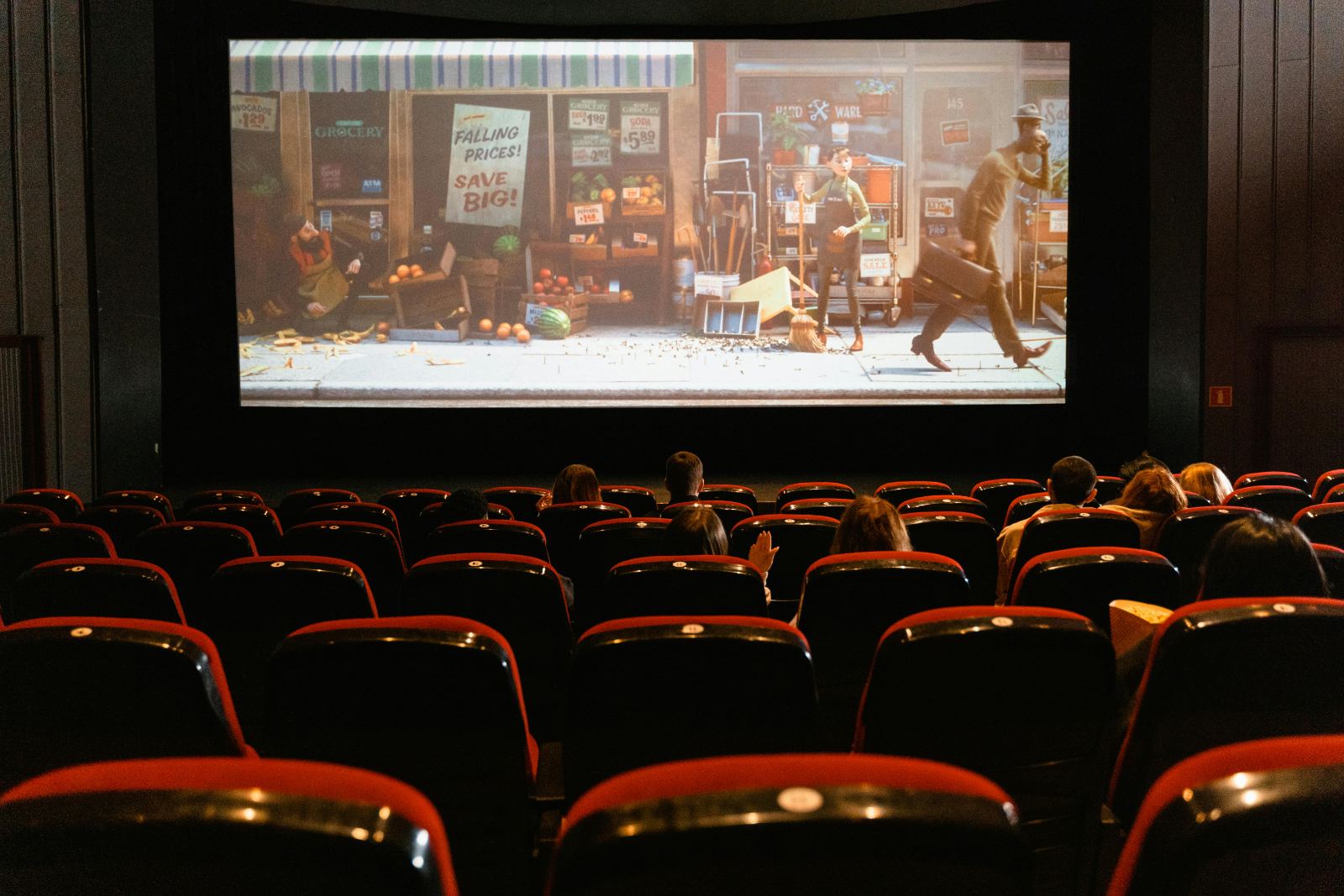
Why do we enjoy putting ourselves in the position of characters and judging their decisions? Why do we experience a fictional scenario as a personal matter? Why do some films stay with us for ever? What we are really talking about is the viewer’s readiness to accept the cinematic world as real in order to enjoy the narrative. This tendency is known as the “willing suspension of disbelief”, and historically it derives from the Greco-Roman principles of theatre, where the audience sets aside the fictional nature of what it sees in order to experience catharsis through the actions and experiences of the characters.
The cinematic experience works as a safe simulation of reality. Viewers temporarily move away from the obligations and constraints of everyday life and immerse themselves in a world of imagination, where they can symbolically step “outside” themselves and experience life through other perspectives. As Nietzsche argued, art allows us to bear the truth of our finite existence. Through the willing forgetting that comes while watching a film, a person attempts to transcend their existential anguish and their ontological loneliness. At the same time, narrative works as a bridge between past, present and future, carrying experiences and meanings that help viewers shape their values and their choices.
Cinema is not simply an experience of viewing but a deeply emotional one. The images, the characters and the stories activate feelings and provoke identification or resistance. Viewers watch from a safe distance, but at the same time experience events from within. In this way a distinctive form of empathy and self-observation blossoms, which can even have therapeutic value. The combination of image, music, dialogue and lighting strengthens this experiential quality, allowing cinema to pass through our usual defence mechanisms and activate deeper aspects of the self.
Through this process, the unconscious communicates with the conscious through symbolic images, making it easier for viewers to recognise elements of themselves that they find hard to externalise or admit. The psychological mechanisms of projection and identification are considered particularly important in recognising unresolved issues in the psyche. Viewers often project their own characteristics or feelings onto the characters in a film: they may reject a character because he reflects their own unwanted sides, or admire another because she embodies qualities they themselves desire.
Take an example from a film we all know, Dead Poets Society. In the final scene, after the students have been pressured by the school authorities into signing a statement supporting the dismissal of their beloved teacher, the atmosphere is heavy and tense. The students watch their teacher return to the classroom to collect his personal belongings, when the quietest student among them suddenly rises and climbs onto his desk, calling out: “O Captain! My Captain!” Little by little, other students follow him, despite the headmaster’s strict orders.
This scene creates intense emotional charge in the viewer, while identification is powerfully activated: viewers recall people who once inspired them, or moments when they wanted to defend their values but hesitated. Through the students, the viewer’s own rebellious spirit is awakened, and they symbolically live the courage to express respect and gratitude by resisting authoritarian power. At the same time, the scene functions as a form of catharsis, with the students’ act offering a sense of moral and emotional restoration. The film, then, works not only as narrative but as a mirror of inner experience. Viewers are brought face to face with questions of moral value — justice, authenticity and freedom of choice — something also expressed through the famous phrase the teacher passes on: Carpe Diem.
Overall, we might say that watching films opens an inner dialogue in which viewers meet aspects of themselves through the stories of the characters, leaving room for thought, understanding and personal meaning-making. Films are not merely a distraction from reality, but also an opportunity to return to it with a deeper awareness of ourselves and our experiences.
References:
Ferri, A. J. (2007). Willing Suspension of Disbelief: Poetic Faith in Film. Lexington Books.
Münsterberg, H. (2006). The Photoplay: A Psychological Study. (Greek edition: Kathreftis, Athens.)
Freud, S. (1999). Gesammelte Werke, Die Traumdeutung, vol. II. Berlin: Fischer.
Wedding, D., Boyd, M. A., & Niemiec, R. M. (2005). Movies & Mental Illness: Using Films to Understand Psychopathology. Ashland, OH: Hogrefe & Huber.
Wijsen, L. (1980). Cognition and Image Formation in Literature. Frankfurt: Peter Lang.
Papaleontiou, M. (2014). Literary Literacy in Prose: Elements of Narrative Theory.