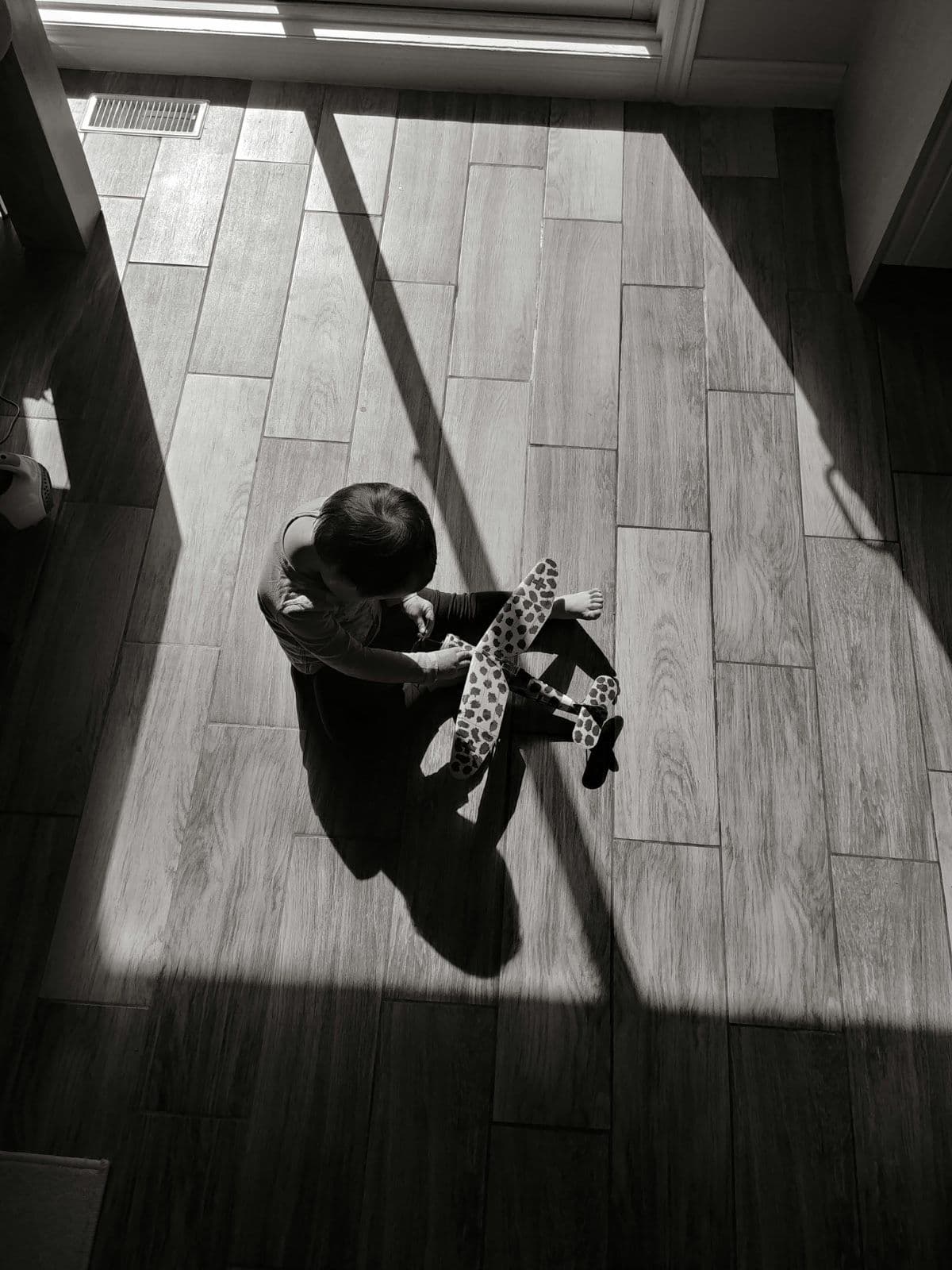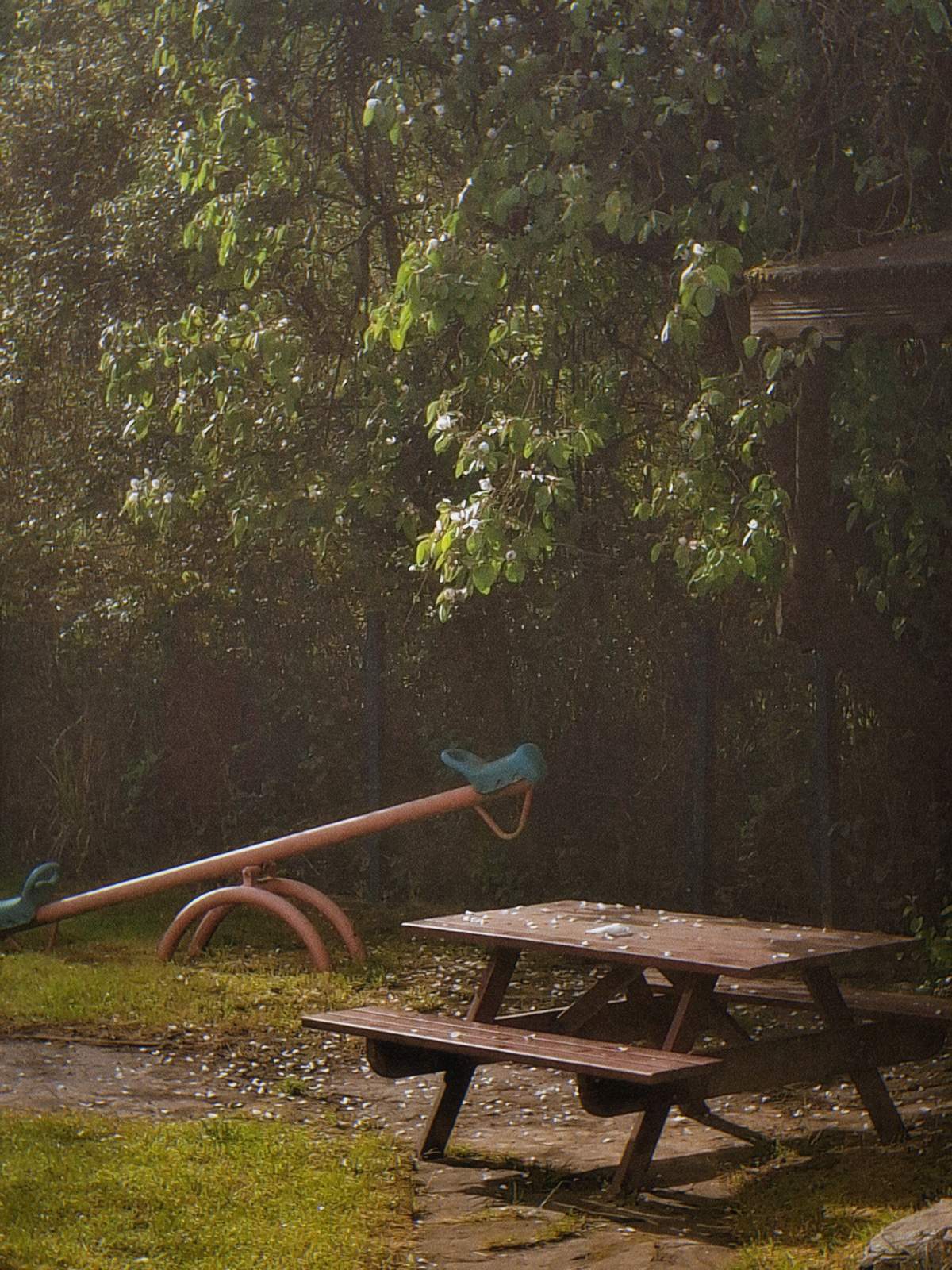
There are images that do not necessarily remind us of any particular memory.
An empty child’s bedroom. A living room furnished in the style of the ’90s. A neglected playground. A swimming pool with no one in it. An old sofa, a television with thick glass, a window looking out onto a garden.
Looking at them, we may feel something strange.
A sense of connection with something old. A sweetness. A melancholy. Sometimes even an inexplicable sadness. And the strangest part is that we may not remember anything specific — no memory of our own, and yet all of them at once.
Something inside us says: I know this place. Or, more accurately, I know how this place makes me feel. As though we had once visited it in a dream. As though we were returning, for a few seconds, to a life we cannot quite remember.
When we feel nostalgia for something we do not remember
In recent years, a kind of aesthetic has emerged online that tries to give form to this feeling that is so difficult to describe.
Dreamcore, weirdcore, nostalgiacore, liminal spaces.
They are not exactly the same thing. Often, however, they meet at a common point: in images that feel at once familiar and foreign, real and dreamlike.
Dreamcore, for example, often uses blurred and surreal imagery, while weirdcore is more closely connected to a sense of strange familiarity, confusion and a vague nostalgia. Online communities often describe this experience as “nostalgia for an era I never lived in”, or “as if I miss a place I have never been to”, or “as if I am remembering a dream from years ago”.
And here an interesting concept appears, one that has become known over the past few years: anemoia. The term comes from John Koenig’s The Dictionary of Obscure Sorrows and is used to describe the feeling of nostalgia for a time, a place or a reality we have never experienced. It is not, therefore, a memory in the literal sense. It is more of an emotional relationship with something we know through imagination, images, stories and cultural memory. This distinction is also discussed in a recent Psychology Today article, which separates nostalgia for personal experiences from anemoia, which concerns experiences we never lived.
And perhaps this word explains something that many people struggle to put into words.
How can we miss an era we never lived in?
Nostalgia, in its psychological sense, usually concerns a personal experience of the past. A summer. The house where we grew up. Childhood weekends. School friends. Christmas at our grandparents’ house. A period of our life that genuinely existed. And although it is bittersweet, nostalgia can serve positive functions. Research has linked nostalgic recollection with greater social connectedness, positive emotion, a sense of self-continuity and meaning in life.
Anemoia is different. Here we are not returning to a memory of our own. We imagine that we are returning to something that was never ours. We might look at a house from the 1980s and imagine what it would have been like to grow up there. We might see an old playground and feel that we once played there. We might hear music from a time before we were born and feel a strange familiarity. There is no memory of having lived it — there is imagination. And this is one of the most interesting features of human memory: that we can not only reconstruct our own past, but also mentally place ourselves in times, places and lives we never lived.
Why do houses from the ’80s and ’90s stir such strong feelings in us?
A house is not simply a space.
It is a container of memory and experience.
Children do not only remember what happened inside a house. They learn the world through its spaces: the height of the door, the light in the kitchen in the afternoon, the floor beneath their feet, the sound of the fridge, the smell of food, the sofa they fell asleep on, the room they played in, the temperature of the tile they used to lie on.
So when, later on, we see a similar space, we do not need to consciously recall a specific memory.
Something far more diffuse and embodied may be activated: a bodily memory that this is roughly how I felt the world when I was small.
Research on autobiographical memory shows that recollection is not a simple replaying of stored events. Memories are connected to how we perceive ourselves and are organised within broader stories about our lives. The development of the “self” is an important part of how autobiographical memories are formed and maintained.
And there is another interesting finding.
Adults tend to remember a disproportionate number of personal experiences from adolescence and early adulthood. The phenomenon is called the reminiscence bump. It does not mean that childhood is necessarily the period we remember most, but it shows how significant the early years of identity formation are for autobiographical memory.
These periods are full of “first times”: first friendships, first losses, first independence, first dreams, first experiences of the world outside the family. Personally, although I do not remember much from my childhood, I remember the feeling I had when I first started travelling with my friends from the small town where I lived into the centre of the big city, half an hour away.
So we do not only remember what happened back then.
We often remember how we felt as we began to know more of the world.
Nostalgia is not only a wish to go back
The word “nostalgia” often carries the idea of a sweet sadness about the past. Contemporary psychological research, however, treats it with greater complexity.
Nostalgia is an emotion that is at once bittersweet and deeply bound up with personal and social memories. It can arise when we feel alone, disconnected or emotionally strained and, paradoxically, it can function as a form of emotion regulation: strengthening our sense of connection, self-esteem and self-continuity.
In other words, when we return in our minds to a significant period of the past, we are not simply looking backwards.
We are reminding ourselves that we were once a child, an adolescent, a young person who was afraid and dared anyway, who hesitated but tried, who did not know much but wanted to learn the world.
In this way, nostalgia can create what researchers call a sense of self-continuity: the sense that the person I am today is connected to the person I was then. Studies have shown that nostalgia can strengthen this sense of continuity, partly through social connectedness, and in doing so can also strengthen our sense of meaning in life.
What we are looking at may no longer exist
The past is not simply far away.
It is something that will not come back.
The house we grew up in may still exist, but not as we remember it. The people have changed. Some have gone. The rooms have been repainted, the furniture replaced. Video cassettes gave way to DVDs and then to digital files.
What we feel nostalgic for is not only a place.
It is the way we experienced life within that place.
And that way cannot return.
Perhaps this is why a photograph of an empty child’s bedroom can stir up so much feeling in us.
We can almost imagine the child who ought to be there.
The toys that are no longer on the floor. The voice that cannot be heard. The child we once were and cannot become again.
This may also explain the fascination of liminal spaces.
The word liminal comes from the Latin limen, meaning threshold. It describes something that lies between two states: neither exactly here nor there, neither old nor new.
An empty corridor. A school after the lessons have ended. A playground at dusk. A hotel with no people in it. A shopping centre just before it opens.
These are spaces that would normally be full of life, but from which life has temporarily withdrawn.
This creates a strange psychological effect: the space is familiar, but something is missing.
In online discussions, people describe exactly this feeling: “familiarity but a strange atmosphere”, “places that should have people in them but have no one”, “as if I have been there as a child, even though I know I haven’t”.
Someone even describes liminal spaces as a form of anemoia: nostalgia for a time you never lived.
Can we feel nostalgia even for something that never happened?
This does not necessarily mean that we have “false memories”, or that we remember events that never took place.
We may be feeling nostalgia for a possibility, or an experience we would have liked to live.
A childhood we wish we had had. A home we did not have. A family we wish had been different. An era we did not live in but have come to know through photographs, films, music, stories and images.
Sometimes, then, the object of our nostalgia is not a real memory but a corrective emotional scenario.
“What would it have been like if…”
If I had grown up somewhere else.
If my family had been different.
If I had been around in that era.
If I could live again those years when everything still seemed innocent. If I had gone out with that group of friends, to that place.
Perhaps this is one reason why images from the ’80s and ’90s can move even people who never lived that reality.
We do not need to have been inside one particular house in order to recognise something of the feeling of “home”.
Nostalgia as a small grief
There is, however, a subtle sadness within this experience.
Because every nostalgia contains both presence and absence.
I remember something, and precisely because I remember it, I know that it is over.
I feel warmth, and at the same time I feel that this warmth belongs to a time I cannot return to.
This is why nostalgia can be so strangely bittersweet.
It is not simply sadness for what has been lost.
It is also gratitude that it once existed.
And perhaps this explains why nostalgia, despite its melancholy, has been associated in research with greater social connectedness, a sense of self-continuity and meaning.
The past does not return.
But it can visit us through our memories.
Through a rusty seesaw. A song. A particular light. An old television set. An empty room.
And for a few minutes we may feel again something of the world as we sensed it back then.
Perhaps, in the end, it is not the era we are nostalgic for
Perhaps what we long for is not really the ’80s or the ’90s.
Nor the houses, nor the furniture, nor the old televisions.
Perhaps we are nostalgic for the experience of still being at the beginning of our lives.
The sense that time is infinite.
That the people we love will always be there.
That there is innocence in the world, and a kind of carefreeness.
That home will stay the same.
That summer will return every year and the holidays will never really end.
Perhaps this is why an image of an old child’s bedroom can move us more in our thirties or forties than it ever could have moved us when we were children.
Back then we did not know that this was our childhood, or that one day it would end. I sometimes wonder when was the last time I slept over at my best friend’s house as a teenager, or the last time we played The Sims on her computer, or the last time we were in the garden of our house. I cannot remember — but those images that carry this sense of childhood nostalgia take me back to those bittersweet memories.
We look at a photograph of an empty playground and, in its stillness, we meet not only the child we once were, but everything we dreamed of back then.
And perhaps, for a few minutes, that connection is enough.