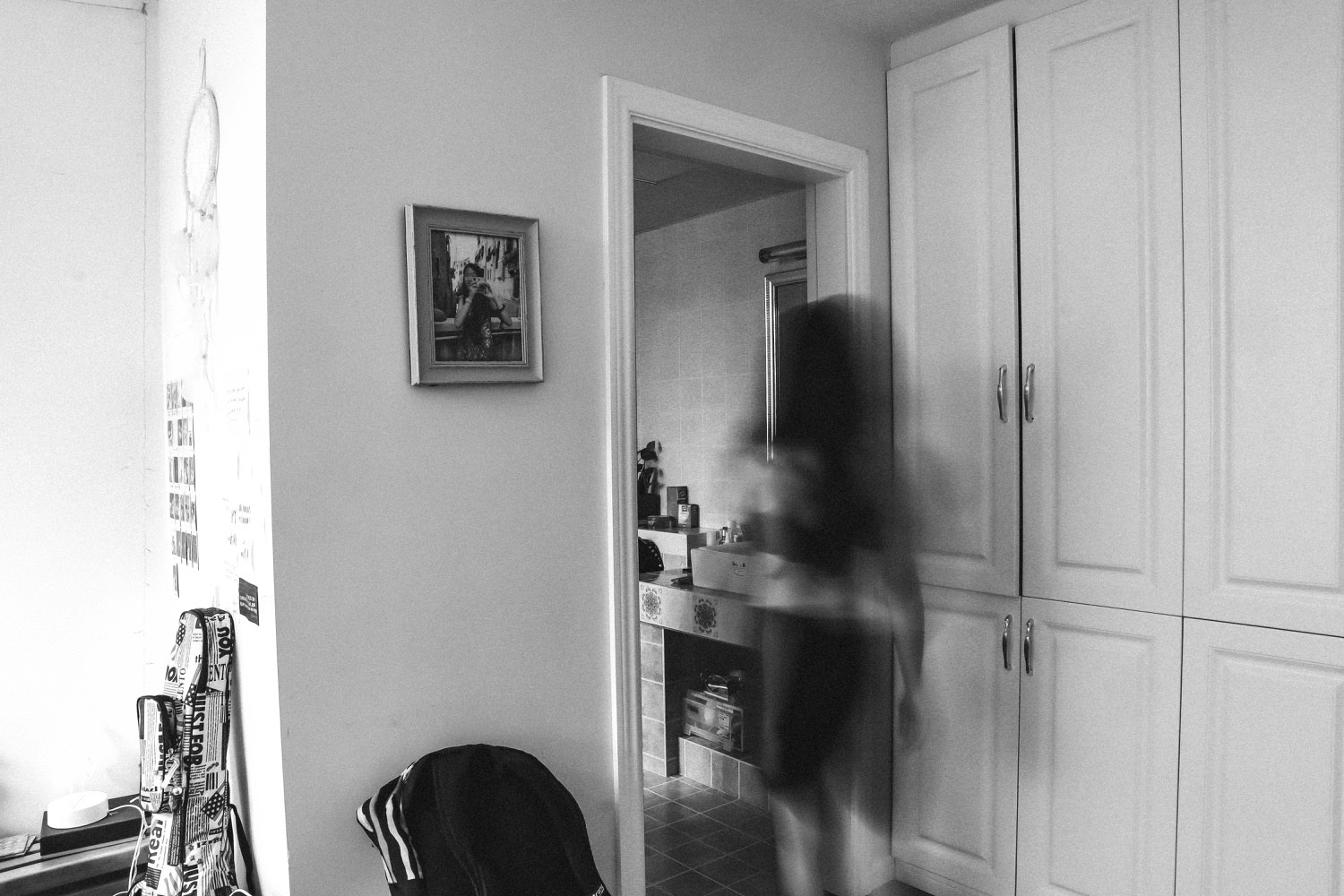
“I kept thinking about what I’d done. Did it seem strange? Why did I do it? Maybe I shouldn’t have reacted like that?”
Thoughts like these can arise even about something very simple and everyday — how we greeted someone, or how we behaved for a moment in front of others.
There are times when thoughts like these, about something we did or did not do in our daily lives, keep replaying inside us for hours or even days after an event. As if we cannot make peace with it, as if we cannot accept ourselves, and as if we do not understand why we behave the way we do. As if, at the moment something happened, our mind was elsewhere, and so, not being present, we acted in an uncoordinated, mechanical way, not as we would have wished. And then the thoughts come afterwards to remind us that we did not behave as we would have liked, but as we thought we should — without it being a choice that was really our own.
So when certain thoughts arrive, it is as if a dialogue opens up in our mind that we cannot detach ourselves from.
“Why did they say that to me? What did they mean?”
“Maybe I shouldn’t do what I’m thinking of doing?”
“Maybe I should have answered differently?”
“What would have been the best choice?”
We may replay a conversation in our mind, analyse the other person’s tone of voice or the look on their face, examine every possible interpretation, or try to work out exactly what went wrong.
Sometimes this process helps us understand something. At other times, however, we end up circling around the same thought without getting anywhere. And very often we arrive at the same conclusion: I must have acted strangely, I must have looked stupid, they must have misunderstood me, I made a fool of myself.
This is when we might speak of overthinking or, when thinking becomes persistent and repetitive, of rumination.
Research often distinguishes between two related forms. Rumination is directed mainly towards the past and asks “why?”. Worry is directed towards the future and asks “what if?”. Both belong to what researchers call repetitive negative thinking (Ehring & Watkins, 2008). And both have something in common: thought goes round and round, while we do not move forward emotionally or psychologically, but remain trapped in the same pathways of thought and experience.
Thinking itself is not the problem. The way thinking moves is what creates vicious circles.
Thinking about something that happened is not in itself a negative thing. On the contrary, reflecting on something helps us understand our experiences better, to see whether we would have liked something to happen differently so that we can do it differently in the future, to make decisions and to prepare for what lies ahead.
There is, however, a difference between thinking in order to understand and thinking again and again in order to reach a certainty I may not be able to have. Or in order to exhaust every possible scenario, as if one of them will protect me.
For example, after a difficult conversation we may ask ourselves:
“What didn’t go well? Was there something I could have expressed differently?”
This may lead to a useful understanding.
But when we keep thinking about the same thing, thinking may come to resemble a circuit of self-criticism:
“Why did he say it like that? Was he angry? Did I annoy him? But if I annoyed him, why did he say afterwards that everything was fine? Maybe he just said that so he wouldn’t have to talk about it? Maybe he doesn’t actually like me? And why didn’t I realise it at the time?”
The thinking continues, but it does not necessarily add new information. It recycles the same question, and often the same feelings of disappointment, heaviness and anger.
Some people think much more in words
One interesting finding highlighted by recent research concerns inner speech: the way we use language silently, in our heads, when we think.
For some people, thinking resembles, to a large extent, an inner dialogue. They talk to themselves silently, ask questions, answer them, rehearse what they will say, or comment on what is happening.
For example, before a difficult phone call, they may be thinking:
“Should I say it now? No, better to wait. But what will I say? Should I start with what happened yesterday? Will I sound aggressive? I should say it more calmly...”
Other people do not experience their thinking in such a verbal way. They may have more images, sensations, feelings, or an immediate sense of what they want to do, without describing it to themselves in sentences.
In a large study with more than a thousand participants, researchers found considerable differences between people in how much inner speech they experience. Those who had more of it also reported that they much more often rehearse conversations that have not yet happened and rewrite, in their minds, conversations that have already taken place (Nedergaard & Lupyan, 2024).
This does not mean that one way of thinking is better than the other. Inner speech is simply one of the ways in which we may think.
When inner speech turns into relentless analysis
Inner speech can help us put a thought in order, remember something, or prepare for a difficult situation.
But it can also become the medium through which we keep recycling an experience, while remaining emotionally in the same place.
Research points to an interesting difference here (McLaughlin, Borkovec & Sibrava, 2007). When we worry, we think mainly in words: what might happen, what we will say, how the other person will respond, what we will do if the worst happens. It is an inner dialogue that keeps running ahead, towards the future.
When we keep thinking about something that has already happened, the words are more often accompanied by images as well. We replay the scene: the other person’s look while we were speaking, their tone of voice, their posture, how others reacted. And on top of these images, the same questions return again and again:
“What did they mean?”
“Why did they do it?”
“What should I have done?”
“What will happen if it happens again?”
The inner voice is not, in itself, the reason we keep thinking about the same thing. But it can become the “vehicle” through which the cycle continues.
Do we think so that we do not have to feel?
Research on worry suggests something that is very familiar to us in Gestalt psychotherapy. Verbal thinking may keep bodily and emotional experience at a distance (Borkovec, Alcaine & Behar, 2004). As long as we are talking to ourselves about what happened, we do not have to feel what happened: the pain, the anger, the shame, the rejection, or the fear that we might be left.
Fritz Perls used to say that we often talk “about” our lives instead of being in our lives. Overthinking is perhaps one of the clearest examples of this.
In Gestalt we speak of retroflection as a defence: what would have been directed towards the other person is turned back towards ourselves. And perhaps thinking about the same thing over and over is often exactly that.
The questions we do not ask the other person, we ask ourselves endlessly.
“Why did you say that to me?” is a question that could be asked out loud. When it is not, the other person stops being someone we can ask. They become a screen onto which we project our own fears: that they don’t like us, that they are angry, that they will leave. And then we are no longer in conversation with them. We are in conversation with the image of them inside us.
Perhaps this is why the thought keeps coming back. Something has been left open — an unfinished experience that is asking to be completed. We try to complete it through thinking, when often it could only be completed through real contact. This is also why grief, whether for a death or for a separation, may become heavier when words have been left unsaid that still hurt us (Klingspon et al., 2015). And we may catch ourselves returning again and again to the same conversations, looking for a different ending that will bring the relief we long for.
But why does someone need to analyse something so much?
Behind overthinking there is often more than simply the need to find an answer. There may be a need to feel safe and to reduce the uncertainty we feel about ourselves and our relationships.
If I can understand exactly why someone pulled away, perhaps I can prevent it from happening again.
If I can understand what the other person was thinking, perhaps I can avoid rejection.
If I can find what I did wrong, perhaps next time I can do it right and avoid feeling uncomfortable.
In this way, overthinking may resemble an effort to protect ourselves and feel safe. When I have not learned to feel safe simply being myself, and I have learned to watch what I say and how I say it because otherwise there are consequences, then overthinking becomes a protective world of its own.
The mind tries to predict what will happen, to detect danger, and to find a way of making sure we will not struggle again.
The problem is that in human relationships, and in life more generally, we cannot have complete certainty.
We cannot know exactly what someone else is thinking. We cannot predict all of their reactions. And we cannot control whether someone will reject us, distance themselves from us, or misunderstand us.
The more we try to eliminate this uncertainty through thinking, the more questions — and the more anxiety — may be generated.
The distance no thought can bridge
Irvin Yalom speaks of existential isolation: however close we become to another person, there is always a distance between us that never fully closes. We cannot enter the other person’s mind. We cannot know with certainty what they feel about us.
Perhaps overthinking is, at a deeper level, an attempt to close this distance through thought. To learn from within ourselves what can only be learned through the relationship — and never completely.
The same is true of decisions. Yalom describes how every decision also carries a loss: when we say “yes” to something, we are saying “no” to something else. Endlessly analysing a choice may be a way of not having to lose anything.
And yet, as long as we do not choose, we lose something else: time, and the life that is waiting to happen.
Kierkegaard called anxiety “the dizziness of freedom”. Perhaps overthinking is a way of holding on to thought, like a lifeline, so that we do not have to feel this dizziness.
“Did I say something wrong?”
Overthinking is often linked to the way we see ourselves within relationships.
A person who has learned to observe other people’s reactions very closely, as a way of being, may constantly be trying to read the signs:
“Why didn’t they reply straight away?”
“Why were they more distant today?”
“Did what I said bother them?”
“Did I do something without realising?”
Attention is continually directed towards the other person, and towards what every small change in their behaviour might mean.
And then a simple uncertainty can turn into an entire inner dialogue — one that may have its roots in the way I learned, from childhood, to observe the world.
And somewhere here, the need for control appears
Overthinking can be a way of trying to gain control over something that, in reality, cannot be controlled.
If I go over a conversation enough times, perhaps I will understand what the other person really meant.
If I anticipate every possible scenario, perhaps I will be prepared for anything.
If I analyse every detail of a decision, perhaps I can make sure I will not get it wrong.
But life does not offer us that kind of certainty.
At some point, thinking needs to stop — not because we have found all the answers, but because we recognise that not everything can be known in advance.
Not every thought needs to be resolved
This may be one of the hardest lessons for someone who overthinks.
When a thought appears, we tend to believe that we have to answer it.
“Did they take offence?”
“I need to find out whether they took offence.”
“Why didn’t they reply?”
“I need to find out why they didn’t reply.”
But some questions do not have an available answer.
And some thoughts do not need to be resolved. They need to be acknowledged and allowed to pass.
I can think:
“I don’t know what they meant. I can only find out if I ask them. Until then, there are many possible explanations.”
This is not giving up on thinking. It is a different way of relating to it.
What is happening now, as I think?
One of the simplest questions in Gestalt is also one of the hardest: what is happening now?
Not “What did they mean?”, but: how is my breathing affected as I think about it? Is it short and shallow? Where is my body tightening? What do I feel if I set the question aside for a moment?
Sometimes, if we stay there for a little while, the thought recedes on its own. Not because we found the answer, but because we found what the answer was trying to cover. It may be the feeling that I was hurt or felt rejected. Or the fear that we do not matter enough to others. Or the anger that one of our boundaries was crossed.
In Gestalt psychotherapy we say that change does not come when we try by every means to become something else, but when we become more fully what we already are (Beisser, 1970). And although this may not seem to make much sense at first, in practice it means that we do not need to stop the thought, or push it away by force. What we need is to develop the capacity to observe it closely enough to see what accompanies it.
Perhaps, in the end, the question is not “How do I stop thinking so much?”
But rather:
“What need is hidden beneath this thought?”
Is it trying to protect me from rejection?
Is it trying to prepare me for something I am afraid of?
Is it trying to find certainty and safety where there is uncertainty and anxiety?
Is it trying to avoid a feeling that is difficult for me to feel?
When we look at it this way, overthinking stops looking like simply a “bad habit of the mind”. It may be one of the ways in which we try to look after ourselves, to protect ourselves, or to control ourselves and our future.
And then perhaps we do not need to fight the thought.
References
- Beisser, A. (1970). The paradoxical theory of change. In J. Fagan & I. L. Shepherd (Eds.), Gestalt therapy now (pp. 77–80). Science and Behavior Books.
- Borkovec, T. D., Alcaine, O. M., & Behar, E. (2004). Avoidance theory of worry and generalized anxiety disorder. In R. G. Heimberg, C. L. Turk, & D. S. Mennin (Eds.), Generalized anxiety disorder: Advances in research and practice (pp. 77–108). Guilford Press.
- Ehring, T., & Watkins, E. R. (2008). Repetitive negative thinking as a transdiagnostic process. International Journal of Cognitive Therapy, 1(3), 192–205.
- Kierkegaard, S. (1980). The concept of anxiety (R. Thomte, Trans.). Princeton University Press. (Original work published 1844)
- Klingspon, K. L., Holland, J. M., Neimeyer, R. A., & Lichtenthal, W. G. (2015). Unfinished business in bereavement. Death Studies, 39(7), 387–398.
- McLaughlin, K. A., Borkovec, T. D., & Sibrava, N. J. (2007). The effects of worry and rumination on affect states and cognitive activity. Behavior Therapy, 38(1), 23–38.
- Nedergaard, J. S. K., & Lupyan, G. (2024). Not everybody has an inner voice: Behavioral consequences of anendophasia. Psychological Science, 35(7), 780–797.
- Perls, F., Hefferline, R., & Goodman, P. (1951). Gestalt therapy: Excitement and growth in the human personality. Julian Press.
- Yalom, I. D. (1980). Existential psychotherapy. Basic Books.